Serving this collection was an eye-opening opportunity for me to look at collections of art from a different angle. We’re inspired to make art and be creative depending on our singular view of an artwork, and this sticks us to the surface. In other words, if one looks at a body of work collectively, the difference that it makes is that it takes you to the depths of the creative world. This archiving experience made me ask questions such as: why does an artist choose to create art in collections and not in singular pieces, and why does Khayat have so many various forms to express one message? These questions were provoking me to overthink my creativity and to see the difference, I had to create differently: collective works versus individual works.
It’s hard to look through a good archive and not have certain sensations rise; we are experiencing it. One can gain insight into Khayat’s art by experiencing his body of work; moreover, one can investigate the cultural significance and the periods of Kurdish art during that specific era, which Khayat worked in, and this is only possible with the existing archive. Since there wasn’t a culture of preserving heritage and documenting great works, many parts of Kurdish history, especially our cultural and artistic sides, are missing.
Here, Kashkul comes in. With the authentic agenda of finding that creative aspect and preserving what is present, a great project such as The Visual Archive is born with a handful of visionary young hearts who are aware of what they’re doing and of the importance of their work. Kashkul’s creative space has been a formative guide in learning the process of making archives and in continually rediscovering what becomes possible with their products, with how personal and impactful these collections can be. The collection doesn’t only hold the artwork, but such valuable words from the artists, interviews, and notes with the patience of the ants that build a city underground with single grains of dust. Every art piece’s description shows the given care and attention it deserves. Each piece in Khayat’s collection is a narrator of a story, of every individual who has faced injustice and grievance on our land. In most of his work, I see his take on the tragedies of the destructive fate of being Kurdish, we’ve grown up hearing about and continue to be its witness ourselves.
I came into this collection working on its metadata; I wasn’t there when the team worked with Khayat himself and created the archives in his presence. But now, the digital exhibitions take me back in thought, making me wonder how priceless it must have been to engage with an artist in the act of preserving every collection he produced in his lifetime—and what it must feel like, as an artist, to know that your works won’t fade into oblivion like those of many Kurdish artists, writers, and poets we’ve lost but will be preserved, studied, and lived for generations through this archiving project. Khayat collaborated with others throughout his life, and sharing his archive with Exeter University feels like a faithful acknowledgment of that collaborative spirit.
The first time I saw Ismail Khayat’s work, it felt like a dream made from the soil, sky, and the sorrows of Kurdistan. Faces emerged from cracked earth; birds hovered between flight and capture; colors bled into one another like memories too urgent to fade. Born in 1944 in the border town of Xaneqîn, Khayat carried the mountains and rivers of his homeland into his canvases; he also carried its wounds. Working over fifty years, we saw him rise with the modern Kurdish art, and spoke of himself as only a witness.
Khayat’s work told universal stories of what’s felt, what’s seen, what’s survived. His art also showed the fluid, flowing lines of a pen that seemed as if to create beauty so easily, and this in itself spoke of hope. It invited you to linger. Exhibited across Europe, the Middle East, and America, his work didn’t lose its grounding in the Kurdish landscape, even as it learned to speak more and more the visual language the world saw.
His Voice in the Archive
We interviewed Khayat in Slêmanî, in his gallery, in the Kashkul office. We toured Xaneqîn, Pîrer and Helebce with him; he spoke about his earliest memories of drawing: “Students were taught English on the figures I drew. I watched movies in Xaneqîn Cinema, and always drew the scenes and the characters on the margins of any book I had at hand. These were my first trainings.” That resourcefulness never left him. Even in times of war, when materials were scarce, he found ways to keep creating.
He talked with us on the themes in his work. The recurring masks, he explained, came from a childhood memory of villagers covering their faces during dust storms: “A mask can hide you from the world, but it can also protect you from it. In our lives, we have needed both.” The birds were, in his words, “my messengers. They carry the news of our people to places I cannot go.”
And perhaps most strikingly, when we asked him about the political edge of his art, he told us: “I do not paint politics. I paint life. But life is political.”
When we were repainting the stones with him in Pîrer, the no man’s land between the PUK and KDP during the civil war, he had so many stories to tell us: “The project started with a Board advocating for peace that consisted of six members from both KDP and PUK. This place was divided, but the part in which I worked belonged to neither party. I brought both sides to pay for this project. The art in this place connected the two parties together. I collected all the bullets around that area, dug a hole, and buried them there. I was not sure the project would have what results. But, it became the subject of family discussions in their homes. Some critique was that I bolded the borders between the parties, but I replied that what I created was a beautiful necklace to nature.”
The Kashkul Archive
At Kashkul, we’ve always worked to keep cultural memories safe. When we began archiving Ismail Khayat’s work, we understood the gravity of the task. It was the preservation of a lifetime’s witness. We catalogued hundreds of items, from large canvases to sketches, each one a fragment of Khayat’s journey.
We wanted his voice documented, too. The interviews became as important as the images, because they carried his humor, his words, and his eyes. We grew as people when creating this archive; it was teaching us approaches, styles we would come back to.
From Sulaimani to Exeter
This year, the digital archive will travel to the University of Exeter. The decision to host his works there is a continuation of Khayat’s lifelong conversation with the world, and all that he taught us about what collaborations can do. Exeter’s commitment to Kurdish and Middle Eastern studies offers a platform where his art can speak to scholars, students, and the public far beyond Kurdistan’s borders. From the Kashkul Visual Arts, the digital exhibition will also bring the journey we took with Khayat to create this archive.
His Enduring Legacy
At Kashkul, we were never just working with Ismail Khayat. We were friends who talked about art over tea, who argued about colors and symbols, who planned projects and exhibitions with equal parts tangles and laughter. His presence in our space, even as he spoke so softly, carried an energy that seemed to fill the whole room.
I last saw him at Kashkul’s Through the Smoke Behind the Curtain exhibition for Hawre Khalid. Ismail arrived in a denim jacket and jeans, casual in his style, but also active in his style. He was always urging us to rally together for something left unfinished, a campaign, as he’d call it—”Let’s run a campaign to reorganize the paintings,” “Let’s rally together to finish the digitization.”
That day, he wasn’t feeling well. That didn’t matter, he went to art exhibitions, cultural events just the same.
After that night, we never met again. Shene and I left for the US on December 21, 2019. The very first person to call us in Iowa City was Ismail Khayat. His voice brought warmth to the city’s shocking cold. That would be the last time we spoke.
It’s striking how the little things remain. The way he would lean over a table at Kashkul. The way he looked so closely at an artwork in his gallery. The small sweetener tablets he added to his tea. I would look at him in a room full of people, see him always looking, and know he was soon sketching on paper.
At Kashkul, we archived his colors and lines in the hope of archiving the history he poured into them. And in my mind, his denim jacket, our last phone call, the quiet knowledge that friendship, like art, often outlives us, complete the archive.
Ismail once told me, “Art is the only passport they cannot confiscate.” In the journey his work takes from Slêmanî to Exeter, I am reminded that in sharing his legacy, we honor not only him but the lasting stories in his art.
To me, arts and culture are two of the most important things that require preservation, and this is exactly what this digital archive’s purpose is. Indeed working, in collaboration, on something so great as a first experience has been beyond my pleasure, and especially within the Kashkul environment. This opportunity I have received has not been strictly within the boundaries of a working experience, it has given me a chance to connect with the works of an artist, his insights, and to thrive personally and professionally through the stretch of its potential.
An archiving process is not simple. We brought back previously collected metadata, created through many meetings with the artist and a walk through their artistic journey. After reviewing all the data one folder at a time, we began translating the content into both Kurdish and Arabic to make it accessible to all audiences. This process raised frequent questions about whether we were capturing the artist’s purpose as he shared it with us, and for this we frequently went back to the transcript of his interviews. Although it required great attention, the thoughtfulness of it made the process fulfilling.
Other than the technical aspects of the work, there are other ones to highlight as well. I have come to learn plenty on Khayat’s perspectives and ideals through his works and the descriptions he has given them, be his love for Kurdistan, showcasing the beauty of the body and life, or his emphasis on human nature and their connections through his sketches. He has a very unique vision, which needs an observant eye and represents the depth of his artistic self. I say this because while adding the description data and what the purpose of each specific piece is about, I have found myself spending plenty of time trying to understand how the piece achieves the purpose he has aimed for. It is this part of the process that brings me the most satisfaction, learning about things that I did not expect, let aside help in archiving them. Another important aspect of the work has been adding descriptions to the pieces that we have not been able to gather precise and exact information on and have only achieved the general overview of the series. To fix this issue, after getting in touch with Dr. James and seeking advice on the professionality of adding what has not been already stated, we came up with the idea that for artworks that are not very vague, through the help of the general background of the series and the title of the artwork, we add some perspective through our lens and specify that this has not been stated by the artist himself, rather was gathered by us through the contexts we have been given clearly. This is done so without going extremely beyond the overall idea because we aim at the prevention of any alteration in how his works have been shared initially.
Therefore, archiving, especially that of Ismail Khayat’s works, for me, is not just a process of putting down and sorting out the information that has been gathered, it is rather a journey of learning, exploring and broadening my horizons.
The Twentieth-Century Global MENA Histories Primary Source Collection has been long in the making. It began around 2020, with me believing I could create it myself, using a variety of primary sources I had collected over the years. That was a fancy. My sources were not sufficiently varied, and my knowledge and time too limited. Hence, I began asking colleagues for contributions. Many, many agreed, for which I am deeply grateful. I am equally in debt to the Exeter University DAME team led by Dr. James Downs, who agreed to online-publish this collection free of charge. The DAME team has done a wonderful job making the collection presentable, formatting it, and tagging it in both English and Arabic. (The collection was originally meant to be published at the Wilson Center Digital Archives in Washington, DC, but the US Administration’s decision, in early 2025, to downsize that center nixed that possibility.)
The collection includes 83 contributions. Most feature one source, a few two or more sources. All include a blurb that contextualizes the source(s) and provides select bibliographical references.
The sources focus on the twentieth century—not because it forms a homogeneous unit, but for a practical reason. To cover a whole century even only somewhat adequately, many dozens of contributions were needed. Adding the nineteenth century would have overwhelmed my editorial and organizational capacities. (I hope somebody will create such a collection, though!) As most contributions are multi-thematic, I have listed them chronologically rather than ordering them thematically.
I have tried to keep the collection as diverse as possible. All decades of the twentieth century are covered, though some more than others. All sorts of fields are dealt with, including societal interactions, politics and governmental matters, international relations, culture and the arts, economic matters including finance, production, consumption, and trade, environmental issues, medicine, science and technology, transport and communication, migration and diasporas, religion, and ideologies and political thought. The primary sources were written in 19 languages: Arabic, Armenian, Chinese, Dari, English, French, German, Greek, Hebrew, Italian, Japanese, Malayalam, Ottoman Turkish, Persian, Portuguese, Russian, Spanish, Turkish, and Urdu. Primary source types comprise a range of newspaper and magazine articles; varied documents from governmental and non-governmental archives; speeches; books, including biographies, autobiographies, and diaries; government, NGO, and INGO publications; unpublished manuscripts; letters; advertisements; photographs; a set of oral history interviews; and a stock exchange share. Finally, the sources regard relationships between and across MENA and all (other) parts of the world, i.e. the Americas, Australia, Asia, Africa, and Europe.
À propos geography: as this collection is not a sharp argument, but hopes to be an expansive educational tool, its definition of MENA is broad. I told the contributors that it ranges “from Morocco eastwards to Egypt; Sudan; the Arab East including Palestine/Israel; Turkey; the Arabian Peninsula and the Gulf; and Iran,” and that “I am also open to sources involving adjacent areas, e.g. Mauretania, very late Ottoman or post-Ottoman southeastern Europe, the Caucasus, Afghanistan, and Pakistan.” Similarly, this collection does not subscribe to—let alone promotes—a uniform definition of “global.” I told the contributors that “for this collection’s eminently practical, educational purposes, any source that documents a relationship between MENA and non-MENA (peoples) fits the bill.”
Seen as a whole, the collection’s primary sources involve, and reflect on, fundamental social categories such as gender, race, class, and religion that per se are not MENA-specific. Moreover, most themes are not exclusive to MENA, but, rather, show how thoroughly MENA (sub)region(s) and actors formed part of, were shaped by, and helped shape developments that created the modern world. These developments include, for instance, wars such as World War I and II; colonialism and empire building, including the Ottoman, British and post-WW2 international American ones and MENA actors’ places in, and engagements with, those imperial formations; settler colonialism and reactions thereto; migration to, from and across MENA, and diasporas; nation-state-building in a globalizing world; governmental issues such as urban planning; modern scientific, technological, and medical questions; various ideologies including Islamism and communism; the formation of authoritarian postcolonial states; artistic and cultural relationships; transport and communication infrastructures; and capitalism in its various forms, including finance and agriculture.
At the same time, there are some broad global themes in which (shifting parts of) twentieth-century MENA and MENA actors often played a relatively central role. The two most important examples are oil and Islam in its varied socioreligious forms.
Finally, (changing parts of) MENA and MENA actors often played a pivotal role in the modern world for two interrelated geographical reasons. For one thing, MENA is the only direct neighbor of Europe—and hence quite often directly on the route of, and involved in, world-embracing European imperial expansions and non-European engagements with Europe. For another thing, (various parts of) MENA are (and have been able to construe themselves as) key connectors of Africa, Asia, and Europe. It is not, of course, that geography is destiny: this would be much too simplistic and deterministic a view. And it is not that MENA actors and territories were involved in all planetary, global, or transregional relationships. But MENA’s double positioning—vis-à-vis Europe and in Eurafrasia—seems to have turned its subregions and peoples quite often into arenas and actors in the twentieth-century world.
Mosul Maqam is made possible with the generous support of the British Council’s Cultural Protection Fund in partnership with the UK government’s Department for Culture, Media and Sport. We are grateful for their commitment to preserving and promoting Mosul and Iraq’s cultural heritage
The project is run in collaboration with Kashkul, the centre for arts and culture at the American University of Iraq and Sulaimani (AUIS), the University of Mosul and the “Volunteer With Us” organisation in Mosul. The archive will become a vital digital resource for future scholarship in an accessible format linked and co-hosted at home country institutions like the American University of Iraq Sulaimani and the University of Mosul, encouraging international exchange, partnerships and collaborations.
Maqam
Maqam is the system of melodic modes in the traditional shared musical culture of the MENA region and Central Asia. Iraqi Maqam is one of the oldest and most celebrated forms of Maqam culture, which was inscribed on the UNESCO Representative List of the Intangible Cultural Heritage of Humanity in 2008. The people of Mosul (Iraq) share a special connection with Maqam due to the city’s geographic location as a cultural crossroads, as well as their remarkable capacity to preserve and transmit centuries-old social values, customs, and artistic expressions.
Before the invasion of Iraq in 2003 and the subsequent events that led to the occupation of the city by ISIS, the melodic sounds of Maqam filled the streets ranging from vendors promoting their products, in kitchens, coffeehouses, at weddings, and when visiting the public baths. Unfortunately, these sounds are disappearing today as Maqam is an oral tradition and is only taught through a direct contact between the Maqam master and their students. During years of war and difficulty in meeting each other, and the older generation loss who were more vulnerable to war.
All that has remained from the Maqam reciter Layth al-Kani Family recording Library after ISIS Confiscation Photo taken by Bryar Bajalan
Music production and musicians in Mosul have been targeted through terrorist attacks since 2003. ISIS killed and imprisoned musicians. Performers began clipping their nails to play the guitar quieter and burying their musical instruments in their gardens to hide them. Khalid al-Rawwi, one of the talented musicians who participated in our workshops and will be featured in our upcoming album alongside young 13 Mosuli artists and Amir El-Saffar, had to conceal his oud in a rice bag to avoid kidnapping and potential death just for carrying a musical instrument. ISIS turned the Spring Theatre in Mosul into a prison and place of execution, while the Maqam house was left in ruins.
Street in Mosul’s old city. Photograph by Lana Kamaran
Mosul Maqam is a research project set up to safeguard vibrant Iraqi maqam music and protect it for future generations. The project is designed to preserve a record of the musical and lyrical heritage of forms of Maqam in Mosul, Iraq. Preserving Maqam means preserving stories of daily life: ramblings in the old city, slipping secret letters to future wives, and picnics at monasteries in spring. Maqam is significant beyond social heritage and material significance (i.e., the physical creation of the musical tradition). It has spiritual importance, having been used for years in calls to prayer and church choirs. Further, it can be understood as a spiritual framework which can ground the process of healing after years of war. For example, the most loved Maqam singer in Mosul, Malla Othman al-Mosuli, requested in his last will to be buried with a specific Maqam entitled, ‘Ya Elahi qad Raja Minka al-Huda’ asking for the mercy of God. Maqam helps people to remember those who were lost in the war and commemorate the memory of those yet to be found in mass graves. It brings back the soapy clean scent of the orange blossom on summer nights and propels the Tigris River into the tents of refugee camps and the cold living rooms of the diaspora. This is to say, Maqam is uniquely precious to the local population, as well as to Mosul’s former locals in the diaspora; its value is acknowledged by Iraqi society beyond Mosul. It is also important in many other Middle East contexts, where musical traditions trace their origins to Mosul Maqams, including the famous songs of Sayed Darwish, one of Egypt’s greatest musicians. Even the limited recordings of Mosuli Maqam music on YouTube bear witness to the importance of this heritage as a symbol of hope for those who have entered Mosul’s walls. Ultimately, Maqam explains itself best, for ‘Maqam’ in Arabic means Sanctuary.
Project Milestones and Upcoming Archive Content:
Sound Archive: Mosul Maqam archive comprises both living experts of Maqam and the various data surrounding it. It compiles and archive the traditional Maqams of the city on digital and social media platforms easily accessible to people in Mosul and internationally. The archive includes digitized collections of Maqam recordings that has rare vinyls, reel to reel, tape cassettes, and documents on Mosuli Maqam that are digitised for the first time and made available with both Arabic and English description.
Ammar Taha Showing Family Metadata at Al-Rabi’s Recording Shop – one of the oldest recording stores in the city that was closed down by ISIS in 2014 and just re-opened after the war), Mosul. Photo taken by Bryar Bajalan
Oral History Interviews: To date, we have gathered 31 hours of interviews with Maqam reciters, collectors of Maqam in the city, and musicians who were trained by the late Maqam reciters recounting their memories of specific Maqam recordings from their collections and their cultural life with Maqam.
Ammar Taha – Oral History Interview. Photo taken by Mahmood Jumaa
Educational Workshops:
Oral History Training: The project provided research training in oral history and professional community research and media techniques, including co-created knowledge and sensitive archival practices. This training equipped a Mosuli fieldworkers and local volunteers as they curated their heritage for the Maqam festival, supporting their long-term goals of becoming cultural ambassadors and scholars.
Mosul Maqam Lessons:Eleven lessons on Mosulawi Maqam were held at the Faculty of Fine Arts at the University of Mosul, providing knowledge of Maqam art to 40 participants in Mosul. All classes are now accessible online, and we explored 15 Maqams in detail with Maqam master Ramiz al-Rawi.
Innovation in Maqam Workshops: A two-week training and musical workshop were conducted for a diverse group of 14 young artists by composer Amir El-Saffar at the Volunteer with Us headquarter in Mosul. These workshops support innovative ways to create new art forms; speak to younger audiences and open up multiple realities, narratives and futures grounded in authentic practices.
One of many workshops led by the world-famous Iraqi-American composer and Maqam reciter, Amir El-SaffarBan Shakeeb, Mosul Scholar and Pianist – Oral History Interview. Photo taken by Tahany Saleh
Album and Festival:
We recorded the innovative musical pieces created during the workshop in an album set to be released later this year. Additionally, we hosted a festival that attracted over 600 attendees, making it a joyful and impactful experience for everyone involved. The Maqam Festival took place in Mosul Forest on September 27, 2024, featuring Maqam masters Ramiz al-Rawi and Fakhri Fadhil, along with workshop students and Maqam lesson participants who incorporated Maqam into their contemporary works.
Mosul Maqam team takes Festival guests to the Bytna Foundation community Museum. Photograph by Lana KamaranMosul Maqam Festival in Mosul Ghabat Park
Mosul Forest is home to beloved recreational spaces on the city’s left bank. Once used by ISIS to train fighters and recruit children, it celebrated Mosul’s resilience and Mosulis’ commitment to bringing the city back to life. A special highlight at the festival was the attendance of the renowned Iraqi Maqam reader and Iraq Idol, Mohammed Sajad.
Comic Book: Later this year, Kashkul at the American University of Iraq Sulaimani will publish a comic book that was prepared by an all women team who have received training, access to the necessary archives, and support to interview their family members. Both young artists have limited memories of Mosul before the war and are reconnecting with their heritage, city and families through this project. The comic book which covers stories of Maqam in an inclusive way with a specific focus female Maqam practitioners who are less visible in the Maqam scene.
Mosul’s Witness: retrospective of Muḥammad Jawad Kaḍim’s photography: The first retrospective and indeed the first curated show of Jawad Kaḍim’s work, that features a selection of the photographer’s most iconic images of historic Mosul, from photos of ordinary Moslawi children playing to rare images of the city’s 1963 flood. The exhibition ran from 12 February to 31 March 2024 at the Street Gallery in the IAIS at the University of Exeter.
Maqam is an artisanal art form, with many Maqam reciters also being skilled weavers, jewellery makers, carpenters, and more. Ramiz Al-Rawwi, one of the few Maqam reciters left in the city, and a skilled jewellery maker himself, said, “There were Maqams recited during work. In Mosul, we have specific Maqams performed during various tasks. For example, the Nari Maqam is traditionally recited while weaving fabric on the Jummah. I mean, the wooden loom where threads are placed for weaving.” Sadly, many shops and livelihoods have permanently shut down post-war, resulting in the loss not only of these spaces but also their distinctive soundscapes. This film attempts to revive Maqam and reconstruct the memories and the sonic footprint of the city, extending beyond mere structures. It features music created by talented musicians from Mosul during two weeks of workshops mentored by Amir El-Saffar. We believe cultural preservation must accompany creation. As crafts are being made, so too is the music; the film itself is going into a process of creation that mirrors the ongoing rebuilding of the city, where the musicians put their vision on what rebuilding means to them in music.
In recognition of our shared commitment to the preservation of cultural heritage in the region, DAME provided financial and technical assistance to the Mosul Maqam project as well as the Mosul’s Witness exhibition at IAIS.
Since July 2023, I have been working as a Digitisation Assistant on the Digital Archive of the Middle East (DAME), a collaboration between the Institute of Arab and Islamic Studies (IAIS) at the University of Exeter and the Institute for International and Area Studies (IIAS) at Tsinghua University. The project explores how digitisation can facilitate research into the Middle East and North Africa (MENA), while using digital technologies to make items from the University’s substantial MENA collections openly available online, reducing barriers to access and research. This blog post by DAME Project Manager Dr James Downs outlines the scope of the project and the significance of the materials; others provide detail on specific collections and subjects represented within them.
The Digitisation Assistants take ownership of the digitisation process for individual items, from capturing the photograph to uploading the final file to the web-publishing platform, Omeka. This is the second digitisation project on which I have worked at Exeter, having held previous positions on the Hardy’s Correspondents project. In this blog post, I outline the DAME digitisation workflow, the kinds of material that I have digitised, and the importance of the project.
Workflow
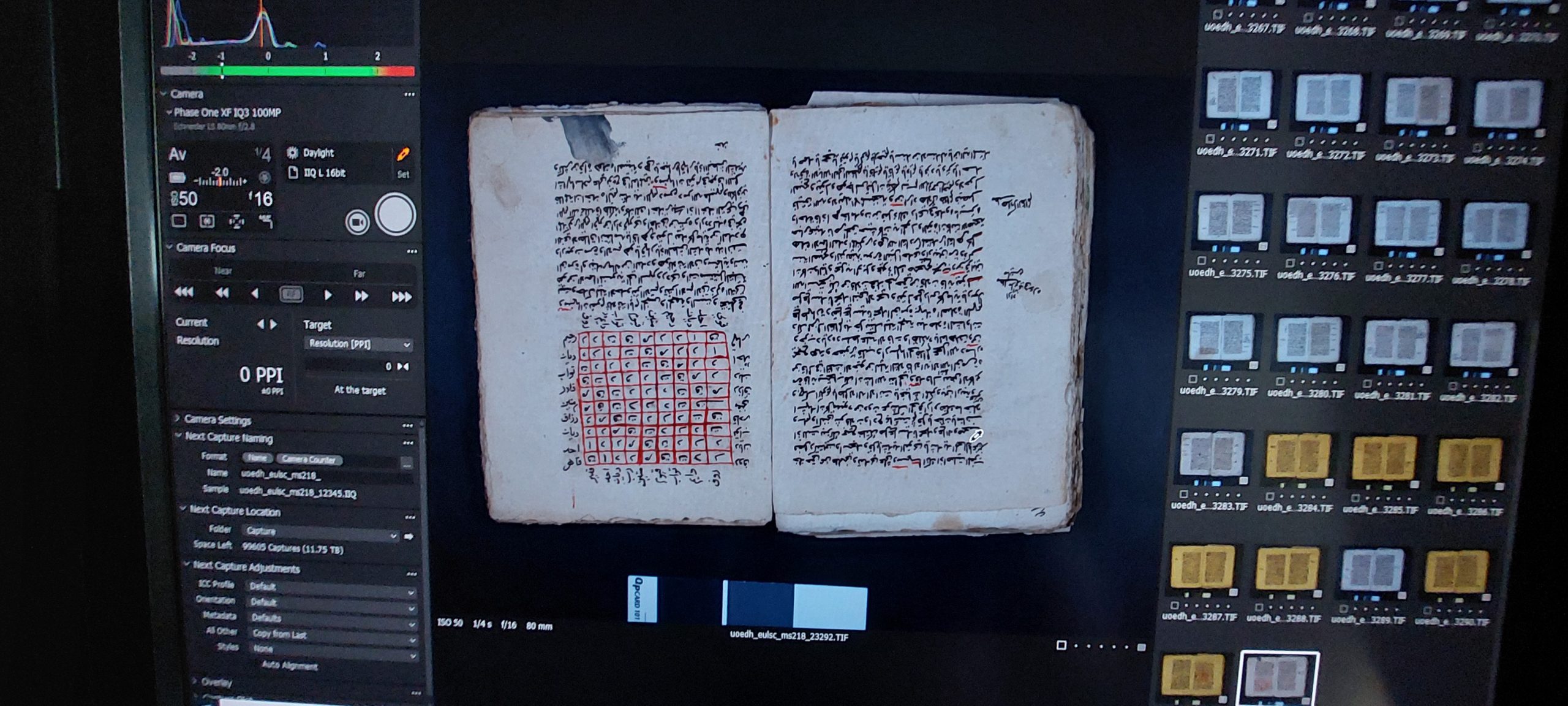
I and the other Digitisation Assistants work between the workstations at the Old Library and the Digital Humanities (DH) Lab on Streatham Campus. The standard setup comprises a Canon EOS R5 camera fixed to a height-adjustable stand and connected to a desktop PC, two independently controllable lights, and a platform where each item is placed for photographing. The specialist equipment in the DH Labs is ideal for photographing a broad range of items, from oversized documents, such as maps, to 35mm slides. We use Capture One software to take and edit the images—straightening, correcting distortion, and balancing exposure as needed—before exporting them as JPEGs (for texts) or TIFF files (for visual materials, such as posters, postcards, and photographs).
The Capture One User Interface, with a page of the Kurdish paper Rya T’eze displayed in the Viewer.
Adobe Lightroom has proven handy for its image-stitching capability, as some Egyptian film posters in the collection were too big to be captured in a single image, even with the larger DH Lab workstation.
Poster advertising the Egyptian film My Faithful Friend, directed by Fadel Saleh. DAME.
For documents, we convert the JPEGs into OCR-readable PDFs using ABBYY FineReader. However, it is not always possible to do this, as not all the languages represented in the collections are widely supported by OCR tools yet.
A PDF of Hatra Antiquities Guide displayed in ABBYY Finereader, with the ‘Recognize Document’ pop-up showing Arabic and English as the selected OCR languages.
The final step is to upload the items to Omeka and add metadata (in Arabic, English, and Kurdish), such as title, format, relevant dates, and subjects, and add them to item sets, which include the Kurdish Digital Archive, History of the Gulf, specific archival collections (Omar Sheikhmous, Chris Kutschera, Al-Azmah), and others. The project generously funded a year of evening language classes, which have enabled me to add basic metadata in Arabic. So far, I have digitised over 4,300 items for DAME.
An item displayed in Omeka, showing the various metadata, PDF link, and Kurdish Digital Archive item set.
From archive to website
The materials selected for digitisation in DAME have great historical, political, and social value. Mostly produced in the twentieth century, they bear witness to historical currents in the region, from the rise and fall of colonial administration to nationalist politics, from increasing prosperity and large-scale development projects to revolutionary movements and everyday lived experiences. Many items are ephemeral, such as circulars issued by popular groups calling for expressions of solidarity from supporters; written for a short-term purpose with no view to longevity, they are a rare glimpse into the urgencies of the moment.
Other items were created to last. Annual reviews by Saudi ARAMCO (Arabian American Oil Company) summarise the activities of the company, including economic and social investments—for example, the building of schools—as well as oil production. Governmental publications provide details on broad areas such as education, health, and the environment: examples include Education in U.A.E. by the UAE Ministry of Education, Protecting our Environment by BAPCO (Bahrain Petroleum Company), and Silemetiya Jina [Women’s Health], a Kurmanji Kurdish booklet published in Armenia. A considerable number of statistical books and censuses from across the region have also been digitised: multiple volumes of censuses in Iraq from 1957, statistical yearbooks from 1970s and 1980s Oman, and a statistical guide to Jordan published for tourists in 1962 are among the dozens that have been completed so far. Such resources allow data on a range of areas, including education, healthcare, population, and economy, to be tracked across time and situated in broader contexts of regional changes.
Front page of Power and Water Affairs: Statistical Book Until 1991, published by the Bahrain Ministry of Works, Power and Water.
Some of the most arresting materials are photographic. Among them are picturesque mountain and desert landscapes, and snapshots of faces, mosques, and streets from 100 years ago.
Many materials are yet to be digitised, but the increased accessibility of the thousands already on the website is, for me, both the motivation and the reward of working on the project. At its core, DAME is guided by an egalitarian ethos: that materials pertaining to the countries of North Africa and the Middle East should rightfully be accessible to the people whose histories they document. I am glad to have been able to contribute to this important and necessary work.
The Kurdish Digital Archive is part of the DAME (Digital Archive of the Middle East) project, hosted at the University of Exeter.
Its aim is not only to digitize and make accessible key Kurdish materials from the University’s own archival collections, but also to collaborate with other Kurdish archives and institutions in fostering joint research, the sharing of archival resources and the preservation and dissemination of Kurdish cultural heritage.
Launched in October 2021, the Digital Archive of the Middle East (DAME) is a three-year research project undertaken as a collaboration between The Institute of Arab and Islamic Studies (IAIS) at the University of Exeter and the Institute for International and Area Studies (IIAS) at Tsinghua University, building upon the 2019 Memorandum of Understanding established between the two institutions. By using new technologies to digitise selected parts of the University’s collections of material from the Middle East and North Africa (MENA) region, the project aims to open up a series of research questions about the potential for digitisation in advancing research.